Research projects · University of Sussex

Vector
Humanities

Humanities research in and on the vector medium. Translations, readings and editions made with the methods of vector theory.

01 · About

Archives, sources and research tools now sit inside the vector medium.

Large language models and diffusion systems hold text, image and sound as positions in high-dimensional vector spaces, and they generate new material by moving through those spaces. In that geometry difference becomes distance and meaning becomes location, and the geometry shapes what can be represented, retrieved and said. Humanities scholars encounter a new mediation of their archives, their students' writing and their own research tools through the vector medium.

Vector Humanities documents new vector projects drawing on the Vector Lab and related tools. Each one has a humanities object at its centre (a book to translate, a corpus to read, an archive to edit) and works on it with methods and theory developed in the wider vector theory programme.

The vector medium is both the instrument and the object of this work. The tools here are built with large language models, and some, such as vector translation, use them on the material directly; the Vector Lab instruments take those same systems as their object of study. A medium used to study itself would be circular if the evidence came from the models' own reports, so the evidence here comes from outside the model: a surviving paper tape, a manuscript leaf, a page image, or a measurement on a model's outputs that can be repeated on the same model.

Vector Humanities also takes a step forward that the vector medium makes possible, here called vector toolmaking1: creating tools, digital or vector-based, that enable humanities scholars to research and work with their materials. The benches, instruments and toolkits under Methods and Approaches are its first examples.

02 · Projects

Current work

Vector theory

Vector Lab

Research instruments for the vector medium

Vector Lab takes the vector medium itself as its object: the geometry of embedding spaces, the token probabilities from which language models generate text, and the paths diffusion models take as they generate an image. Its instruments test interpretive claims about these systems against measurements of their outputs that can be repeated on the same model.

The instruments are Manifold Atlas, LLMbench, Vectorscope, Manifoldscope, Theoryscope and Diffusion Atlas, with Vectorography, which designs type by moving through a latent space of glyphs. The theory they test is set out in ‘Vector theory: epistemology, political economy, and probabilistic computation’ (Philosophy & Technology, 2026).

Status: Manifold Atlas and LLMbench live; the other instruments in alpha.

7instruments
v1.19.6Manifold Atlas
v2.2.30LLMbench
GPL-3.0licence, all seven
Vector translation

The Problem of Contingency

Kuki Shūzō, 1935
vector translated by David M. Berry

A complete English translation of Kuki Shūzō's Gūzensei no mondai (Iwanami Shoten, 1935), his study of contingency in its categorical, hypothetical and disjunctive forms, which has not previously been published in English in full. It is made from the National Diet Library scans of the 1948 printing, which are in the public domain.

The translation was drafted by a swarm of AI agents working through the page images under a shared brief that fixed glossary, register and conventions. Each section exists in a literal version and in the translation, each checked against the other and against the images. The terms, corrections and apparatus are the translator's.

The Kuki Research Bench, built on bench-kit, sets each page image of the 1948 printing beside the translation, with the literal version one switch away, a glossary showing where each rendering falls, the change lists, and a search of the library's OCR.

One case shows the kind of work the bench supports. Its glossary flagged “ground” as the word for two of Kuki's terms, 根據 and 理由. This was a problem as it didn't distinguish between his two definitions. They are now better handled by using 根據 as “Ground” and 理由 as “ground”, and Encounter/encounter (邂逅/遭遇) and Modality/modality (樣相性/樣相) separated the same way.

Status: preliminary translation complete, October 2026; research bench live. To be checked against the Kuki Shūzō zenshū and Omodaka Hisayuki's French translation (1966).

331pages of the 1948 printing
c. 83,000words, translation
471translator's footnotes
22figures from the NDL scans
Book series

Vector Humanities Editions & Contingencies

Two open series of books

Vector Humanities Editions publishes translations made by the vector translation method; Contingencies publishes new commissioned work. Every book is open access under CC BY 4.0 and is published with its workings: decisions log, build report, and the records of corrections between text and typesetting.

In preparation: Kuki Shūzō, The Problem of Contingency, and Florens Christian Rang, Historical Psychology of Carnival.

Status: series page live; first books in preparation.

2series
2books in preparation
CC BY4.0 licence
Research bench

Melville Research Bench

Billy Budd and the short tales
Michael Jonik and David M. Berry

A bench for reading, annotating and comparing Herman Melville's Billy Budd and his short tales in their versions: the manuscript's states of revision, the editions made from it, and the magazine and book texts of the tales. A joint project of Michael Jonik and David M. Berry (University of Sussex).

Billy Budd is read from the Melville Electronic Library's TEI, loaded from MEL's own repository at a fixed commit, not copied. The bench is built on bench-kit, the modules shared by the critical code studies benches.

Status: Alpha

4versions of Billy Budd
449manuscript leaves
3,799deletions encoded
3,509additions encoded
Critical code studies

ELIZA (1964–68)

A critical code studies reading
David M. Berry, Sarah Ciston, Anthony C. Hay, Mark C. Marino, Peter Millican, Arthur I. Schwarz, Jeff Shrager and Peggy Weil

After Inventing ELIZA (MIT Press, 2026), the project turns from the book to the archive. It reads ELIZA as a family of texts: the 1965 MAD-SLIP source and its SLIP library, the DOCTOR scripts and their 1965 tapes, the conversations that survive, and the ports that followed, from Cosell's Lisp to BASIC and C.

The instruments are findingeliza.org; the ELIZA Research Bench, which collates the versions line by line and by routine and carries shared annotation; a public Implementations archive of 138 reimplementations, with their descent and features; and a paratext archive of documents about the program, held privately for the team.

Inventing ELIZA predates the bench, which was created for the work that followed the book's publication. The bench formalises many of the practices the team developed by hand, to make it easier to annotate, collect materials and undertake comparative close readings of source code.

Status: site and research bench live; Implementations archive public; paratext archive in use by the team.

1964–68MIT CTSS, from HELP to the last scripts
21versions, scripts and outputs on the bench
138implementations catalogued
414paratext items
Critical code studies

Spacewar! (1962)

A critical code studies reading
David M. Berry and Mark C. Marino, with Anthony Hay, Sarah Ciston, Art Schwarz, Claire Carroll and Norbert Landsteiner

A critical code studies reading of Spacewar!, the space-combat game written for the DEC PDP-1 at MIT in 1961–62. The original Macro assembly source is read as a cultural text, and a runnable PDP-1 emulator lets the reading move between the listing and the running program.

The Research Bench assembles, runs, compares and annotates the surviving versions; there is no single canonical Spacewar!. The principal output is a monograph, a companion to Inventing ELIZA (MIT Press, 2026).

Status: project site and Research Bench live; monograph in progress.

1962MIT, PDP-1
4PDP-1 version lines
5ports with their own pages
2028monograph expected
Critical code studies

SHRDLU (1968–70)

A critical code studies reading
David M. Berry and Mark C. Marino

A critical code studies reading of SHRDLU, Terry Winograd's natural-language-understanding program, written in MacLisp and Micro-Planner at the MIT AI Lab in 1968–70. Its blocks-world dialogue became symbolic AI's most celebrated demonstration.

The SHRDLU Research Bench, built on bench-kit, reads the source across its surviving implementations, with the program's paratexts catalogued alongside. A companion to the team's readings of ELIZA and Spacewar!.

Status: project site and Research Bench live.

1968–70MIT AI Lab
2languages, MacLisp and Micro-Planner
11implementation files published
363paratext items catalogued
Vector literature

Nostos

A game and web-world in the vector medium
David M. Berry, 2026

Nostos is a vibe-coded isometric game and web-world, built as one long project to test what the vector medium can carry at scale. It wraps a 1990s surface, GeoCities pages, a Netscape browser and a Unix laptop, around a backend generated by large language models, so the content of the new medium is the old one.

It casts the player as a close reader of code, rewarded for going into the source, the archives and the documents rather than taking the surface at face value. A working Standard ML interpreter, checked against a formal definition, runs inside the world, and editing a machine's code is a way to play.

Status: playable beta, in development; subject of the Stunlaw essay Notes on Nostos (2026).

17.7bntokens to build
211,576lines of source
48days of development
1m+words of in-world web

Further projects will be listed here as they begin. Projects led elsewhere that follow the conventions below are welcome; to propose one, open an issue on the site's GitHub repository.

03 · Methods

Methods and Approaches

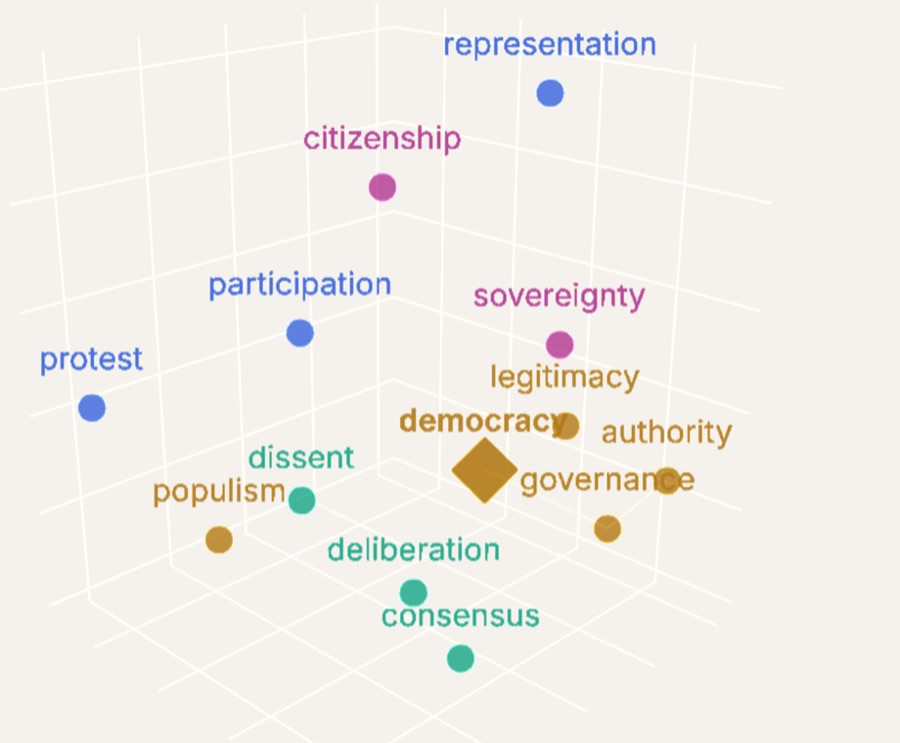
Manifold Atlas neighbourhood map of concepts around democracy

Manifold Atlas

Compares how embedding models place the same concepts: concept distance, the negation gauge, the hegemony compass, neighbourhood maps, persistent homology. It tests interpretive claims about a model's geometry against measurements of that geometry.

v1.19.6 · Vector Lab · Site · GitHub

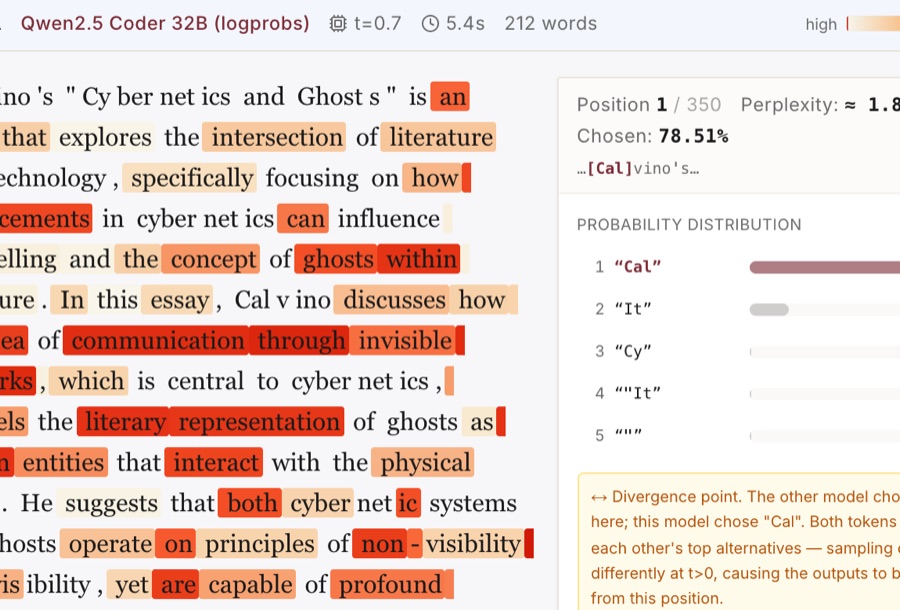
LLMbench probability heatmap with a token's probability distribution

LLMbench

Close reading of generated prose: two models answer the same prompt side by side, with annotation, token probabilities, divergence points and analyses of temperature and sampling.

v2.2.30 · Vector Lab · Site · App · GitHub

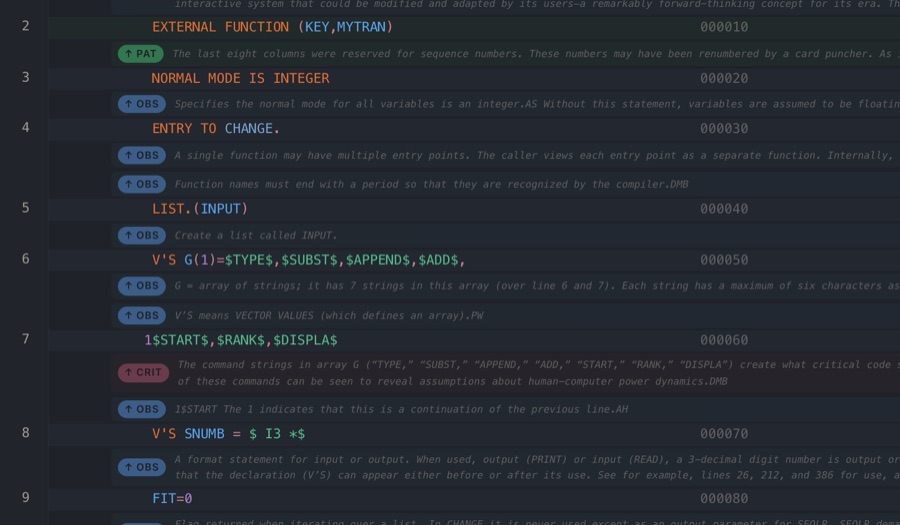
The CCS Workbench showing annotated ELIZA source code

Critical code studies

Close reading of code as cultural text, applied to the code, prompts and agent briefs that do the work in each project.

github.com/critical-code-studies

Computational Hermeneutics title card: the family name in serif type beside a braid of parallel bars joined by curved ribbons, one pair crossing to mark a transposition

Computational Hermeneutics

Research instruments that bring the apparatus of textual criticism, the witness, the siglum, the collation, to code, corpora and machine-generated text. It currently includes CCSbench, based on CCS-WB classic, for close reading of code, Source Variorum for comparing witnesses, and Glas Bench for two-column reading after Derrida. A shared kit, hermes-kit, is in preparation.

Active · Site · GitHub

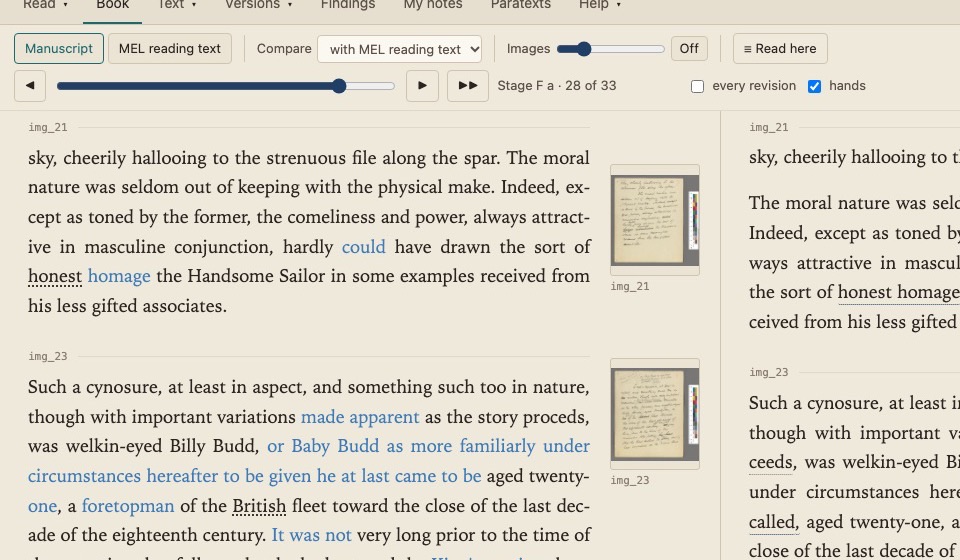
The Melville bench comparing Billy Budd manuscript and reading text with leaf images

Bench Kit

Shared modules for research benches: versions and their genealogy, comparison, annotation shared through Hypothesis, paratexts, findings and export. The SHRDLU, Spacewar!, ELIZA, Melville and Kuki benches are built on it.

critical-code-studies.github.io/bench-kit

Vector translation

A method and toolkit for translating books from page images with AI agents under a translator's direction: the procedure stage by stage, rules learned on the Kuki translation, Claude Code skills for each stage, brief templates, and scripts that check the text and apply corrections. For translators and scholars running a translation of their own.

v0.1.1 · Site · GitHub

Vector Book share card: the title in large type over generated streamlines and a warped grid

Vector Book

Book design and typesetting for vector humanities translations and editions. Markdown section files become print-ready books through Pandoc and Typst, in five designs, from a classic scholarly octavo to books with generated fields and vector imagery. Source page numbers sit in the margin, figures carry English glosses, and every build checks for lost notes.

Alpha · Site · GitHub

04 · Conventions

How projects are kept

  • ProvenanceEach project records its source edition, the scans it works from, and their rights status.
  • AI disclosureMachine drafting is identified as such. Decisions on terms, readings and corrections are logged with their dates.
  • Instrument and materialWhere a model is used to read or measure, the project tries to separate what belongs to the instrument from what belongs to the material.
  • Open AccessPublic-domain sources and project outputs can be published through this work. Open access publications are a key output of this project wherever possible. This project is committed to open science practices.